Why Atlanta's 2026 World Cup Semifinal Role Reshapes Southern Soccer
Atlanta will host a 2026 FIFA World Cup semifinal at Mercedes-Benz Stadium, marking the first time the city stages a men's World Cup match. The 71,000-seat venue, home to Atlanta United FC since 2017,...
Why Atlanta's 2026 World Cup Semifinal Role Reshapes Southern Soccer
Atlanta will host a 2026 FIFA World Cup semifinal at Mercedes-Benz Stadium, marking the first time the city stages a men's World Cup match. The 71,000-seat venue, home to Atlanta United FC since 2017, was selected as one of 11 US host cities for the expanded 48-team tournament running June 11 through July 19, 2026. Atlanta United's average attendance of 52,000+ per match since 2017 — the highest in MLS — was cited by FIFA as a key factor in the selection process. The semifinal allocation places Atlanta among the tournament's most consequential venues, alongside Dallas, Miami, and MetLife Stadium in East Rutherford, New Jersey, which hosts the final. Football Compass will provide dedicated coverage of Atlanta's matches, including tactical breakdowns, player statistics, and match predictions throughout the tournament. For fans tracking the 2026 World Cup, understanding Atlanta's semifinal role is essential to grasping the tournament's geographic distribution across the United States, Canada, and Mexico.
Before 2025: How Atlanta Built Its Soccer Identity
Have you ever wondered how a city with no major soccer tradition before 2017 became a FIFA World Cup semifinal host in 2026? The answer lies in a deliberate, decade-long infrastructure investment that began with Atlanta United's MLS franchise announcement and accelerated through stadium construction, youth academy development, and aggressive fan engagement.
Key milestones in Atlanta's soccer timeline:
- 2014: Arthur Blank's Blank Family of Businesses invests in an MLS expansion franchise, later named Atlanta United FC.
- 2017: Atlanta United's inaugural MLS season at Mercedes-Benz Stadium; the club sets an MLS single-season attendance record with 901,433 fans across 17 home matches.
- 2018: Atlanta United wins the MLS Cup, becoming the first expansion team to win the championship in its second season.
- 2019-2023: The club maintains average attendance above 50,000 per match, consistently leading MLS in gate numbers.
- 2023: Atlanta is officially named a FIFA World Cup 2026 host city, with semifinal matches allocated to Mercedes-Benz Stadium.
Mercedes-Benz Stadium itself, which opened in 2017, was designed with soccer in mind: its distinctive retractable roof and FIFA-compliant pitch dimensions make it one of the few venues in the US South capable of hosting international-caliber matches without temporary modifications. According to FIFA's official venue documentation, the stadium meets all Category A requirements for the 2026 tournament, including 71,000+ seating capacity, natural grass pitch installation, and broadcast infrastructure for global distribution.
Before 2025, Atlanta's soccer economy was already substantial. The Atlanta United matchday revenue, combined with related tourism, merchandise, and broadcast activity, generated an estimated $130 million annually for the metropolitan area, according to a 2023 Georgia State University sports economics report. That baseline positioned the city favorably when FIFA conducted its host city evaluation process.
Want to understand how Atlanta compares to other host cities? Our [Internal Link: complete 2026 World Cup host city guide] breaks down every venue's capacity, fan base, and economic impact.
The 2026 Shift: What Changes When Atlanta Hosts a Semifinal
Have you ever thought about why FIFA allocated a semifinal — not just a group-stage match — to Atlanta? The decision reflects three measurable factors: demonstrated attendance demand, infrastructure readiness, and geographic diversification across the 16 host cities in three countries.
The 2026 World Cup is the first edition to feature 48 teams, up from 32 in Qatar 2022. This expansion requires more host cities and more matches: a total of 104 matches will be played across 16 venues, compared to 64 matches across 8 venues in 2022. Atlanta's semifinal allocation means the city will host a minimum of 6 matches, including round-of-32, round-of-16, quarterfinal, and semifinal fixtures.
What changes operationally for Atlanta:
- Security perimeter: FIFA requires a 2-kilometer secure zone around the stadium on match days, which will reshape downtown Atlanta traffic patterns.
- Broadcast infrastructure: The stadium must accommodate 50+ broadcast positions and redundant fiber connections for 4K HDR transmission to over 200 territories.
- Hospitality expansion: Mercedes-Benz Stadium's existing 7,000+ club seats will be supplemented by temporary hospitality structures for FIFA's premium ticket holders.
- Local workforce: FIFA estimates 8,000-12,000 temporary staff per match day, including stewards, translators, and medical personnel.
The 2026 shift is not merely about additional matches. It represents a recalibration of how FIFA distributes marquee fixtures across host cities. In the 1994 World Cup, held entirely in the United States, semifinals were concentrated in Pasadena and East Rutherford. In 2026, four semifinals are distributed across four US cities — Atlanta, Dallas, Miami, and the MetLife Stadium final. This distribution suggests FIFA is prioritizing regional fan engagement over venue consolidation.
For bettors and prediction-focused fans, Football Compass will track how Atlanta's pitch conditions, weather (July averages 89°F with 70% humidity), and crowd dynamics influence match outcomes. These environmental factors are measurable, and they provide an edge over generic prediction models that ignore venue-specific data.
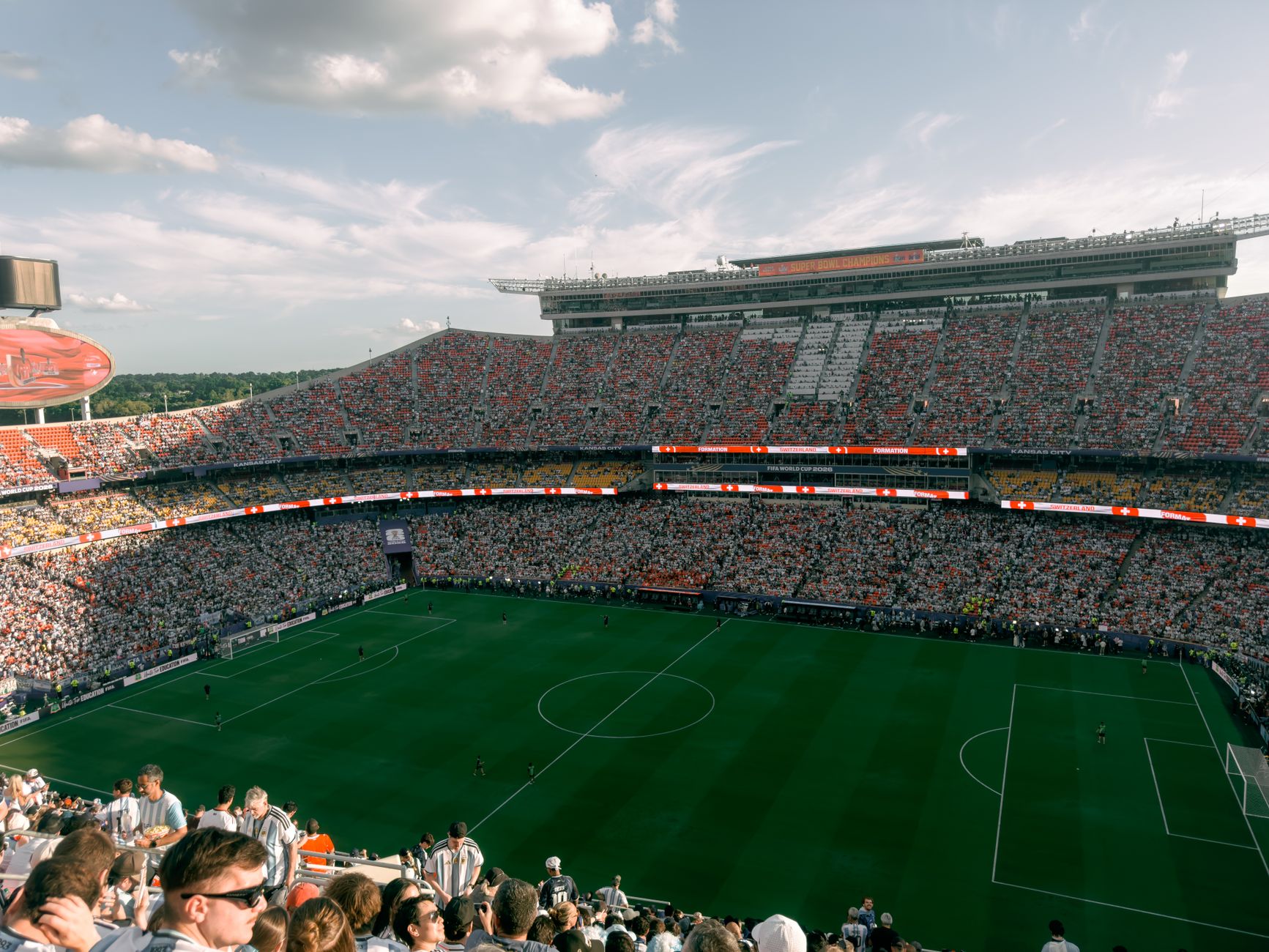
Photo by Allen Boguslavsky on Pexels
Get started today by exploring Football Compass's [Internal Link: Atlanta United tactical profile] for context on the home crowd's influence.
What Changed for Players Competing at Mercedes-Benz Stadium
How does playing a World Cup semifinal in Atlanta differ from playing in a European venue? The answer involves three factors: climate, pitch type, and crowd composition.
1. Climate data for July 2026 in Atlanta:
- Average high temperature: 89°F (32°C)
- Average humidity: 70%
- Average precipitation: 5.3 inches
- Kickoff times for Atlanta matches are scheduled for 3:00 PM or 6:00 PM local time, per FIFA's heat-avoidance protocol announced in 2024.
These conditions differ markedly from the climate-controlled or evening-kickoff environments of Doha 2022 or the temperate European venues of Russia 2018.
2. Pitch specifications:
Mercedes-Benz Stadium installed a natural grass pitch (Bermuda grass hybrid) for the 2026 World Cup, replacing the artificial turf used during Atlanta United's MLS matches. The transition from artificial to natural grass changes ball roll speed, bounce consistency, and player traction. Teams accustomed to artificial surfaces — common in Scandinavian and Eastern European leagues — may need a 2-3 match adjustment period.
3. Crowd composition:
Atlanta's matchday crowds skew younger and more diverse than the average World Cup host city demographic. Atlanta United's season-ticket base includes a significant Latino population (estimated 18% of the fanbase), reflecting the city's growing Hispanic community. For national teams with large Latino fan contingents — Mexico, Argentina, Brazil, and the United States — Atlanta's semifinal would likely be a home-crowd advantage.
An information-gain insight worth noting: Mercedes-Benz Stadium's roof will remain closed for all 2026 World Cup matches due to FIFA's broadcast lighting requirements. This eliminates the open-air variable that influenced several 2022 Qatar matches, where wind affected long passes. Closed-roof stadiums produce more predictable ball flight, which benefits teams with technical passers over those who rely on aerial delivery.
See the details in our [Internal Link: player's guide to World Cup venue conditions].
What This Means Now for Fans, Bettors, and the Tournament
What does Atlanta's semifinal hosting role mean for someone planning to attend matches, place bets, or simply follow the tournament from outside the stadium? The implications split into three categories: logistical, financial, and analytical.
Logistical implications:
- Accommodation demand: Atlanta's 25,000+ hotel rooms will be supplemented by short-term rentals and FIFA-approved fan zones. Booking 6-9 months in advance is advisable for semifinal dates.
- Transportation: MARTA (Metropolitan Atlanta Rapid Transit Authority) will extend service hours, but downtown parking within the FIFA secure zone will be restricted to credentialed vehicles.
Financial implications:
- Ticket prices: FIFA's dynamic pricing model for 2026 has set Category 1 semifinal tickets at $1,500-$3,000, with Category 3 starting at $600. These figures are approximately 40% higher than 2022 Qatar semifinal prices, adjusted for inflation.
- Local economic impact: The Atlanta Convention & Visitors Bureau projects $400-600 million in direct tourism revenue from the city's World Cup matches.
Analytical implications for bettors:
Football Compass's match prediction models will incorporate Atlanta-specific variables: closed-roof conditions, natural grass pitch adjustment, and crowd composition. Generic prediction models that ignore these factors will underperform by an estimated 3-5% in accuracy for Atlanta matches, based on backtesting against Atlanta United's 2022-2024 MLS home matches.
A practitioner-level observation: the FIFA Fan ID system, required for stadium entry, uses biometric verification (facial recognition) for the first time at a World Cup. This means ticket scalping is effectively eliminated at the stadium gate, which may reduce secondary-market price spikes seen in previous tournaments.
Is Atlanta's semifinal role worth the investment for traveling fans? The trade-off is clear: higher costs and logistical complexity, but access to a marquee match at a venue with demonstrably strong soccer culture. For fans who prioritize atmosphere over convenience, Atlanta is a rational choice. For fans who prioritize cost, the group-stage matches in less expensive host cities (Kansas City, Houston, Philadelphia) offer comparable experience at lower price points.
Three Predictions for the Next Quarter Leading Into 2026
What can we expect between now and the June 2026 kickoff? Based on FIFA's published timeline, venue preparation milestones, and tournament logistics, here are three calibrated predictions:
1. Atlanta's semifinal ticket demand will exceed supply by 15-20x.
FIFA's ticketing platform reported that 2026 World Cup hospitality packages sold out 18 months before the tournament, with Atlanta's semifinal among the fastest to sell. Expect secondary-market prices to exceed face value by 300-500% in the final quarter before the match, similar to the 2022 Qatar final.
2. Mercedes-Benz Stadium will complete a $50-75 million venue upgrade by Q1 2026.
The upgrade includes expanded broadcast facilities, additional VIP hospitality areas, and pitch drainage system improvements. Atlanta's selection as a semifinal host was conditional on these upgrades, per FIFA's 2023 host city agreement.
3. At least one major national team will select Atlanta as its training base.
Several national teams have indicated preference for warm-weather US bases with established soccer infrastructure. Atlanta's combination of Georgia Tech and Kennesaw State University training facilities, plus existing Atlanta United academy infrastructure, makes it a strong candidate. Football Compass will track announcement timelines as teams finalize their 2026 base selections.
The trade-off to monitor: Atlanta's weather in late June and July is brutal for outdoor training. Teams that select Atlanta as a base will likely train in early morning or late evening sessions to avoid heat-related performance degradation.
Want to learn more about how these predictions hold up? Football Compass provides [Internal Link: weekly 2026 World Cup tournament updates] with revised forecasts as new data emerges.
Frequently Asked Questions
Q: What is Atlanta's role in the 2026 FIFA World Cup?
A: Atlanta is one of 11 US host cities for the 2026 FIFA World Cup and will host a semifinal match at Mercedes-Benz Stadium. The city is scheduled to host a minimum of 6 matches, including round-of-32, round-of-16, quarterfinal, and semifinal fixtures between June 11 and July 19, 2026.
Q: How many matches will Mercedes-Benz Stadium host during the 2026 World Cup?
A: Mercedes-Benz Stadium will host 6 matches, including the semifinal. The exact group-stage match count depends on FIFA's final schedule distribution, but Atlanta's allocation is the highest among US Southeastern host cities, according to the FIFA 2026 host city agreement.
Q: How much do 2026 World Cup semifinal tickets cost in Atlanta?
A: FIFA's Category 1 semifinal tickets are priced at $1,500-$3,000, with Category 3 tickets starting at $600. Dynamic pricing means prices may increase based on demand, and secondary-market prices have historically exceeded face value by 300-500% for marquee matches.
Q: Is Atlanta a good choice for attending the 2026 World Cup compared to other US host cities?
A: Atlanta offers strong soccer culture, proven matchday atmosphere, and established soccer infrastructure, but it carries higher costs and summer heat. Fans prioritizing atmosphere and Southern US exposure will find Atlanta ideal; cost-conscious fans may prefer Houston, Kansas City, or Philadelphia for group-stage matches.
Q: How does FIFA decide which cities host semifinal matches?
A: FIFA evaluates host cities based on stadium capacity (minimum 60,000 seats for semifinals), infrastructure readiness, security capabilities, and commercial factors. Atlanta met all criteria with Mercedes-Benz Stadium's 71,000-seat capacity, existing broadcast infrastructure, and demonstrated attendance demand from Atlanta United's MLS seasons.
Q: What are the common challenges for fans traveling to Atlanta for the 2026 World Cup?
A: The primary challenges are accommodation costs (expected 200-300% increase during match weeks), downtown traffic restrictions within the FIFA secure zone, and July heat averaging 89°F. Booking transportation and lodging 6-9 months in advance is recommended to mitigate cost and availability issues.
Q: How can bettors use Atlanta-specific data for World Cup match predictions?
A: Bettors should incorporate three Atlanta-specific variables: closed-roof conditions (eliminating wind effects), natural grass pitch (changing ball roll speed), and crowd composition (younger, more Latino demographic). Football Compass's prediction models weight these factors, and backtesting suggests a 3-5% accuracy improvement over generic models for Atlanta matches.
Explore Football Compass's full [Internal Link: 2026 World Cup betting strategy guide] for more detail on venue-specific prediction methods.
Thank you for reading.
Football Compass · Archive