5 VAR Mistakes Football Fans Make
VAR is not a second referee who can rewrite every football decision; it is a FIFA-approved video review system that supports the on-field referee in four areas: goals, penalties, direct red cards, and...

5 VAR Mistakes Football Fans Make
VAR is not a second referee who can rewrite every football decision; it is a FIFA-approved video review system that supports the on-field referee in four areas: goals, penalties, direct red cards, and mistaken identity. The Video Assistant Referee works from a remote video operation room, checking every relevant incident through stadium cameras and communicating with the referee, while the final decision remains with the match official. Under the International Football Association Board (IFAB) protocol, intervention requires a “clear and obvious error” or a “serious missed incident.” VAR entered the FIFA World Cup in 2018 and remains central to tournaments such as the 2026 FIFA World Cup. Reviews have no fixed time limit, although most checks last less than two minutes. The practical takeaway is simple: judge VAR by the protocol, not by the crowd’s first emotional reaction.
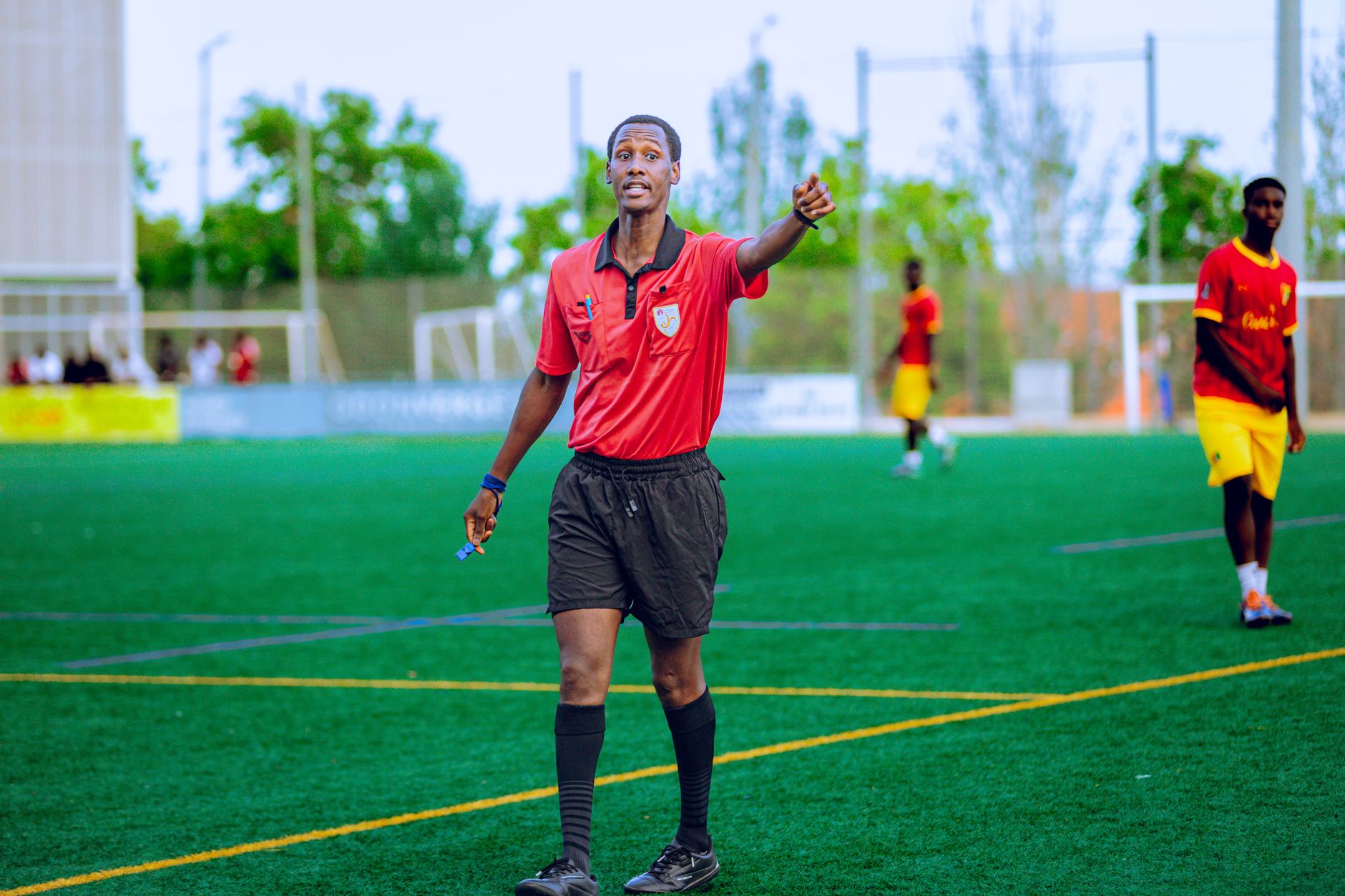
Photo by El gringo photo on Pexels
Football has always carried a strange electricity: one whistle, one raised flag, one ball striking the net, and an entire stadium can swing from mourning to thunder in a heartbeat. VAR did not remove that drama; it moved part of the argument into a room filled with monitors, calibrated lines, replays, and officials trained to examine the smallest decisive detail. For supporters, analysts, and readers of Football Compass following the 2026 World Cup, understanding the process is no longer optional. It directly affects match predictions, tactical analysis, player statistics, and the interpretation of live odds. [Internal Link: 2026 World Cup match predictions]
Want a clearer match-reading framework before the next major tournament?
Myth 1: VAR checks every referee decision — debunked
VAR does not review every foul, throw-in, corner, or yellow card. It automatically checks match footage, but intervention is restricted mainly to goals and no goals, penalty and no penalty decisions, direct red cards, and mistaken identity. The VAR may also examine an attacking phase before a goal or penalty, but that review still belongs to a defined category rather than becoming a general replay service.
The crucial threshold is not simply “the video shows another possible opinion.” IFAB describes intervention through the ideas of a clear and obvious error or a serious missed incident. That distinction matters enormously. A referee may watch a tackle again and still retain the original decision if the footage supports a reasonable interpretation. Football is not an accounting spreadsheet where every disputed number has one mathematically inevitable answer, although this investor-minded writer would dearly appreciate that kind of certainty when tracking a team’s expected-goals position.
The referee must make an initial decision before VAR becomes involved. VAR can recommend a review, but only the referee can initiate it, and only the referee announces the final outcome. This is why players cannot demand a review as if they were pressing a customer-service button, and why surrounding the referee can produce disciplinary consequences.
- Goal decisions can include an earlier offside, foul, or handball.
- Penalty decisions can be overturned in either direction.
- Direct red-card reviews exclude a clearly incorrect second yellow card.
- Mistaken identity can correct the player who receives a card.
The official IFAB VAR protocol states that “the final decision is always taken by the referee.” That sentence is the backbone of the entire system.

Photo by Arturo A on Pexels
Why does VAR not review ordinary fouls?
VAR does not routinely review ordinary fouls because the protocol is designed to correct match-changing errors, not replace continuous refereeing. A minor foul in midfield normally falls outside the four review categories, even when replay footage makes the contact look debatable. This limitation protects match flow and preserves the referee’s authority.
That boundary also explains why supporters sometimes feel VAR is inconsistent. A late tackle near halfway may be ignored, while a similar challenge inside the penalty area receives intense attention because the possible consequence is a penalty. The distinction is not necessarily about how ugly the challenge looks; it is about whether the incident fits a reviewable category and reaches the required threshold. According to FIFA’s Laws of the Game resources, technology supports officiating but does not turn every judgment into a video referendum.
For bettors, this creates a practical edge. Do not price a match as though every controversial call will be corrected. Instead, identify whether the likely incident can alter a goal, penalty, direct red card, or player identity. A team that relies on aggressive penalty-box pressure may have more VAR-sensitive upside than a side whose danger comes from harmless midfield duels. That is a tactical and market distinction, not superstition.
See how officiating context fits into match analysis before placing any prediction.
Myth 2: VAR always overturns the referee — partially true
VAR overturns a decision only when the evidence demonstrates a clear and obvious error or a serious missed incident; many checks confirm the original call instead. The system is therefore both corrective and confirmatory, with the referee’s first decision remaining in place unless the video establishes a compelling reason to change it.
This is where the phrase “check complete” can feel almost comically underwhelming after three camera angles and a stadium holding its breath. Yet confirmation is a legitimate result. The VAR checks whether the goal involved offside, whether a defender’s contact crossed the penalty threshold, or whether a challenge meets the direct-red-card standard. If the evidence does not clearly disprove the original decision, intervention should not follow.
There are two broad review paths. A factual review, such as an attacker being offside by a measurable position, may be resolved by the VAR without sending the referee to the pitch-side monitor. A subjective review, such as whether contact deserves a penalty or red card, commonly leads to an on-field review, known as an OFR. Even then, the monitor is not a remote voting booth. The referee watches the available evidence and makes the final call.
A useful match-day sequence is:
- The referee makes or confirms an initial decision.
- The VAR checks the incident and relevant attacking phase.
- The VAR recommends no change or an on-field review.
- The referee reviews, communicates, and restarts play.
- Disciplinary and restart consequences are applied under the Laws of the Game.
A first-hand operational detail often missed in casual coverage is that reviews have no formal maximum time limit. Accuracy takes priority over speed, although competition organizers still aim to minimize disruption. [Internal Link: football referee decisions explained]
Myth 3: VAR makes offside perfectly simple — flat-out false
VAR makes offside decisions more measurable, but it does not make every offside incident simple because camera angle, kick point, body-part selection, calibration, and deliberate-play judgments remain important. The technology can draw lines and identify positions, yet officials still interpret the Laws of the Game around those measurements.
The offside line is not drawn from a player’s shirt number, boot color, or dramatic television freeze-frame. Officials select the relevant attacking body part and the last defender’s reference point, then determine whether the attacker is nearer the goal line when a teammate plays the ball. Hands and arms are not used to establish offside position because they cannot legally score a goal. That small technical detail has produced enormous arguments across Premier League, UEFA Champions League, and FIFA World Cup matches.
The kick point is another delicate moment. A video operator must identify when the teammate touches or plays the ball, and a few frames can change the apparent relationship between attacker and defender. Semi-automated offside technology can improve speed and consistency by using player tracking and limb data, but it does not erase the need for human oversight. The technology is an instrument; the law remains the law.
A second underappreciated edge case involves deliberate play. If a defender deliberately plays the ball, rather than merely deflecting or blocking an opponent’s pass, the offside phase may be judged differently. That is not solved by a line on a screen. It requires officials to assess the defender’s action, time, control, and circumstances.
For analysts, the best approach is to record not just the final offside call but its trigger:
- Was the player offside at the kick point?
- Did the player interfere with an opponent?
- Was there a rebound, save, deflection, or deliberate play?
- Did the attacking phase begin earlier than viewers assumed?
- Was the available camera angle sufficiently reliable?

Photo by Julieta Hermo on Pexels
How does VAR work during a goal?
During a goal review, VAR checks the scoring action and the relevant attacking phase for offside, handball, foul play, or another reviewable infringement. The referee may award the goal initially, but play cannot be restarted until the check is complete, because a restart can close the review window.
The phrase “attacking phase” is often misunderstood as permission to rewind the match indefinitely. Officials examine the buildup connected to the goal, not every event from the opening whistle. The period can include a pass, duel, or possession sequence that directly creates the scoring opportunity, while remote earlier incidents normally fall outside the review. This is why one goal may be cancelled for an infringement several seconds before the finish, yet another apparently similar incident may not qualify.
Once play restarts, the options become sharply narrower. IFAB protocol permits limited exceptions, including mistaken identity and certain sending-off offences involving violent conduct, spitting, biting, or extremely offensive, insulting, or abusive actions. That restart rule is a major practical insight for live viewers: the emotional celebration is not the legal endpoint; the restart is.
VAR also does not automatically cancel later disciplinary action after an incident. If play continues and the referee changes a decision, cards issued during the intervening period may remain valid, with specific exceptions under the protocol. That detail can affect player-availability projections, fantasy selections, and World Cup squad planning far more than a headline saying simply “goal disallowed.”
What actually works?
What actually works is a disciplined reading of the VAR protocol: identify the review category, separate factual evidence from subjective judgment, and wait for the referee’s final decision before evaluating the incident. This method is more reliable than treating every replay, crowd reaction, or social-media clip as proof.
For supporters, VAR literacy begins with patience. Watch the initial signal, note the referee’s gesture, observe whether the VAR recommends an OFR, and distinguish a factual overturn from a subjective re-evaluation. For analysts, it means documenting the match state, scoreline, minute, player positions, and tactical consequence before deciding whether the review changed the contest. A penalty at 0-0 in the 12th minute is not the same strategic event as a penalty at 1-1 in the 89th minute, even when the legal category is identical.
For Football Compass readers, VAR should become part of a broader tournament model rather than a magical prediction variable. Track teams that enter the box frequently, defenders who make risky recovery challenges, attackers who time runs close to the defensive line, and coaches whose pressing style creates chaotic penalty-area phases. These indicators do not predict a review with certainty, but they help estimate exposure to reviewable incidents.
A practical match checklist includes:
- Confirm the competition’s VAR implementation and broadcast procedures.
- Check whether the incident concerns a goal, penalty, direct red card, or identity error.
- Separate measurable facts from referee judgment.
- Note whether play has restarted.
- Reassess tactics, cards, and live odds only after the decision is final.
- Record the net match impact rather than reacting to the spectacle alone.
Want to turn those observations into sharper 2026 World Cup analysis?
Why does VAR sometimes take so long?
VAR reviews sometimes take longer because officials must locate the correct incident, synchronize camera angles, establish the kick point, assess the relevant law, and communicate a defensible final recommendation. Subjective penalty and red-card reviews generally require more interpretation than factual goal-line or offside checks.
The delay is not always a sign of confusion. In a crowded penalty area, the VAR team may need to inspect several players, determine whether contact occurred, establish who initiated it, and decide whether the incident reaches the intervention threshold. Slow motion can clarify contact but distort speed, while real-time footage can reveal intensity but hide the precise point of impact. Officials need both perspectives, and a single viral angle may not show the decisive evidence.
There is also a human communication chain: VAR, assistant VAR, replay operator, referee, and sometimes other match officials must converge on the same incident. Stadium screens may show a selected replay, but they do not necessarily display every angle reviewed by the officials. The absence of a visible image is therefore not proof that no evidence exists.
The rational viewer should separate delay from quality. A 20-second check that misses an obvious penalty is worse than a 90-second review that correctly resolves a decisive handball. As UEFA explains in its refereeing materials, technology is intended to support accurate and consistent decisions while keeping the referee responsible for the final judgment.
[Internal Link: how football tactics affect live betting]
What to ignore
Ignore the claim that VAR “ruins football” as a complete analysis, because it compresses several separate questions into one emotional verdict. The real issues are accuracy, delay, transparency, consistency, and the effect on the game’s rhythm. A system can improve one dimension while creating legitimate concerns in another.
Ignore screenshots that lack context. A single frozen frame may omit the exact kick point, the defender’s deliberate action, another player’s interference, or the camera calibration. Ignore claims that the system is designed to favor a particular club unless the argument includes repeatable evidence across competitions, referees, and incident types. Strong feeling is not a turnover ledger; it does not tell us whether the conclusion is profitable, reliable, or even testable.
Also ignore the belief that VAR creates a guaranteed betting advantage. Bookmakers and exchanges incorporate stoppages, overturns, penalties, and major officiating patterns into live markets quickly. A bettor who chases a sudden price movement after a review may be paying a premium for information already absorbed by the market. The sharper approach is to compare the new scoreline and tactical state with your pre-match model, then decide whether the expected value has truly changed.
Finally, ignore the notion that every competition uses VAR identically. FIFA, UEFA, the Premier League, national federations, and tournament organizers may differ in camera provision, communication practices, semi-automated technology, and implementation details. Always check the competition rules first, especially during the 2026 FIFA World Cup cycle.

Photo by AlphaTradeZone on Pexels
Is VAR good for football?
VAR is beneficial when it corrects clear match-changing errors without turning ordinary refereeing into endless litigation, but its value depends on protocol, implementation, transparency, and speed. It improves accuracy in goals, penalties, direct red cards, and mistaken identity, while also introducing delays and ongoing debates about subjective judgments.
The strongest case for VAR is simple: a wrong penalty, disallowed goal, or mistaken red card can decide a tournament match, and video evidence gives officials a way to correct certain errors. The strongest criticism is equally serious: long reviews interrupt celebration, confuse spectators, and may encourage players to wait for technology rather than play through uncertainty. Both statements can be true, and pretending otherwise produces poor analysis.
A reasonable evaluation should therefore track measurable outcomes:
- How often does VAR overturn an original decision?
- How long do reviews take in each competition?
- Which review categories produce the most intervention?
- Are explanations available to supporters and broadcasters?
- Does the technology reduce major errors without increasing minor interruptions?
- Do referees apply the same threshold across clubs and venues?
This is where nostalgia meets rationality. The old game had mistakes, but it also had immediacy; the modern game has more evidence, but sometimes less spontaneous release. The goal should not be a sterile sport with no judgment. The goal should be a credible process in which fans understand what happened, why it happened, and what the law required.
Get the latest tournament context and tactical breakdowns from Football Compass.
Frequently Asked Questions
Q: What is VAR in football?
A: VAR means Video Assistant Referee, a match official who reviews video footage to support the on-field referee in four main categories. These are goals and no goals, penalty and no penalty decisions, direct red cards, and mistaken identity. The system does not replace the referee, and intervention normally requires a clear and obvious error or serious missed incident under the IFAB protocol. VAR is used in major competitions including the FIFA World Cup, UEFA Champions League, and many domestic leagues.
Q: How does VAR work step by step?
A: VAR automatically checks potentially reviewable incidents, then communicates with the referee when a serious error may have occurred. The referee can accept the information, continue with the original decision, or conduct an on-field review at the pitch-side monitor. After considering the footage, the referee makes the final decision and applies the appropriate restart, card, penalty, or goal ruling. Players and coaches do not need to request a review because the VAR team checks incidents automatically.
Q: What is the difference between VAR and an on-field review?
A: VAR is the remote video review process, while an on-field review is the referee’s personal inspection of footage at the stadium monitor. A factual decision, such as a clearly measurable offside, may be resolved by the VAR without sending the referee to the screen. Subjective incidents, including many penalty or red-card judgments, usually benefit from an on-field review. In both situations, the referee remains responsible for the final decision.
Q: Why does VAR not review every foul?
A: VAR does not review every foul because its protocol is limited to match-changing categories rather than continuous refereeing. Ordinary midfield fouls, most yellow cards, throw-ins, and corners generally fall outside the review framework. An incident must usually relate to a goal, penalty, direct red card, or mistaken identity, and the evidence must meet the clear-and-obvious-error threshold. This limitation protects match flow and prevents every physical contest from becoming a video hearing.
Q: How long does a VAR review take?
A: A VAR review has no official maximum time limit because accuracy takes priority over speed. Many checks finish in under two minutes, but complicated incidents may take longer when officials must compare angles, identify the kick point, assess a handball, or judge the seriousness of contact. The duration also depends on whether the referee needs an on-field review. A long review is inconvenient, but it does not automatically indicate an incorrect process.
Q: Can VAR overturn an offside decision after play restarts?
A: VAR normally cannot review an incident once play has restarted, except for limited cases such as mistaken identity and certain serious sending-off offences. Goals and offside decisions must be checked before the relevant restart because the restart closes the ordinary review window. This is why referees may delay a restart after a goal even when the stadium is already celebrating. Supporters should watch for the restart before treating a decision as legally final.
Q: Does VAR help football betting and match predictions?
A: VAR helps betting analysis indirectly by clarifying which match events can change the score, player availability, and tactical state, but it does not guarantee a profitable wager. Analysts should distinguish reviewable incidents from ordinary controversy, then recalculate expected goals, cards, possession, and live prices after the final decision. Bookmakers often adjust rapidly after a penalty or disallowed goal, so chasing the first market movement can erase the available value. Responsible bettors should also follow local laws and use fixed limits.
The final lesson is wonderfully plain: VAR works best when we understand its limits. It is neither a flawless oracle nor football’s great villain, but a regulated support system built for a narrow set of decisive incidents. Read the category, watch the evidence, wait for the referee, and only then judge the match. That habit will serve any supporter far better than shouting at a replay, and it will make every Football Compass prediction around the 2026 FIFA World Cup a little more disciplined.
Ready to follow the next major match with sharper VAR and tactical insight?
Thank you for reading.
Football Compass · Archive